The Legend of the Minaret of Death: The Craftsman Behind Bukhara’s Kalyan Minaret
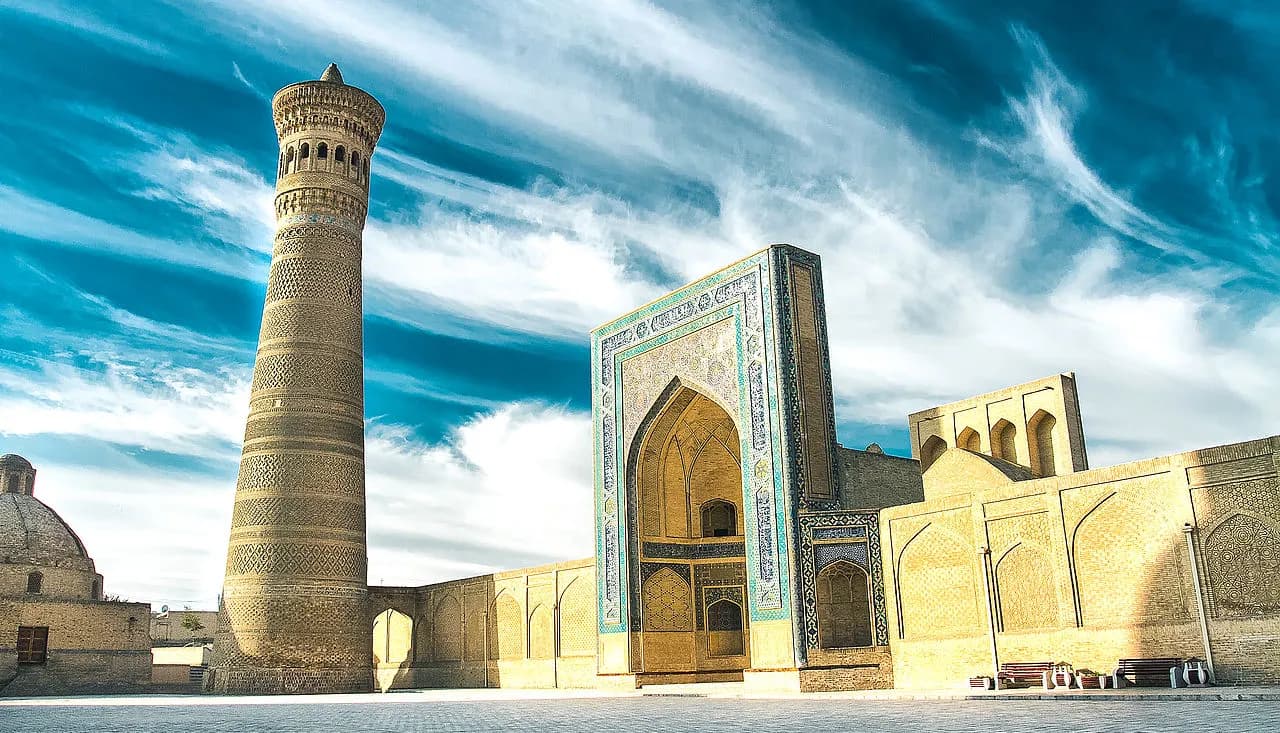
Bukhara’s Kalyan Minaret rises above the old city like a brick compass, guiding visitors toward one of Central Asia’s most memorable historic squares. Stories call it the “Minaret of Death” and tell of a Persian master builder whose skill saved the tower. The legend adds drama, but the monument is also a remarkable work of medieval engineering whose survival can be explored on an ordinary walk through Bukhara.
- The story behind the name
When: The minaret dates to the early twelfth century; the dramatic stories belong to later retellings. Where: Poi Kalyan, the historic centre of Bukhara. The Vibe: A landmark where architecture and oral tradition meet. The tower was commissioned under the Qarakhanid ruler Arslan Khan. “Kalyan” means “great,” while the grim nickname is commonly linked to stories of executions from the tower. Treat that label as a piece of popular memory rather than a complete account of how the minaret was used. Accounts of a Persian craftsman who persuaded a ruler to spare or preserve the structure vary, and should be presented as legend, not settled biography.
- Read the brickwork
When: Visit early in the morning or late afternoon for softer light. Where: View the minaret from the Poi Kalyan courtyard and nearby lanes. The Vibe: Close-up patterns, deep shadows and a surprisingly elegant silhouette. Look for the changing bands of decorative brick, the narrowing shaft and the lantern-like top. The structure’s form is not simply ornamental: its taper and careful masonry helped it stand through centuries of weather and political change. The surrounding mosque and madrasa make the minaret part of a larger urban composition rather than a solitary photo stop.
- Give the square time
When: Allow 60–90 minutes, longer if you are exploring the old town on foot. Where: Combine Poi Kalyan with the Ark, trading domes and Lyabi-Hauz. The Vibe: A living city with workshops, courtyards and evening strolls. A guide can help separate documented dates from the stories repeated by local narrators. Dress respectfully, check current access rules before entering religious spaces, and avoid climbing or touching fragile historic surfaces.
- Make the visit meaningful
When: Plan the square as a morning anchor or an evening walk. Where: Central Bukhara; most old-town sights are walkable. The Vibe: Unhurried discovery rather than ticking off monuments. Stay nearby if you want to see the minaret in changing light, and leave room for tea or a craft workshop. This turns a quick landmark visit into a fuller sense of Bukhara’s scale and rhythm. Travel Tip: The minaret is best appreciated from several angles. Ask your guide to point out the brick patterns and explain which stories are folklore; the distinction makes the visit richer. Plan a Silk Road journey with Minzifa Travel tours, learn about our team, or contact us to tailor a Bukhara visit.
Kommentare
Hinterlassen Sie einen Kommentar
Noch keine Kommentare. Seien Sie der Erste, der seine Gedanken teilt!