Astrology and Power: How Ulugh Beg Measured the Stars in Samarkand
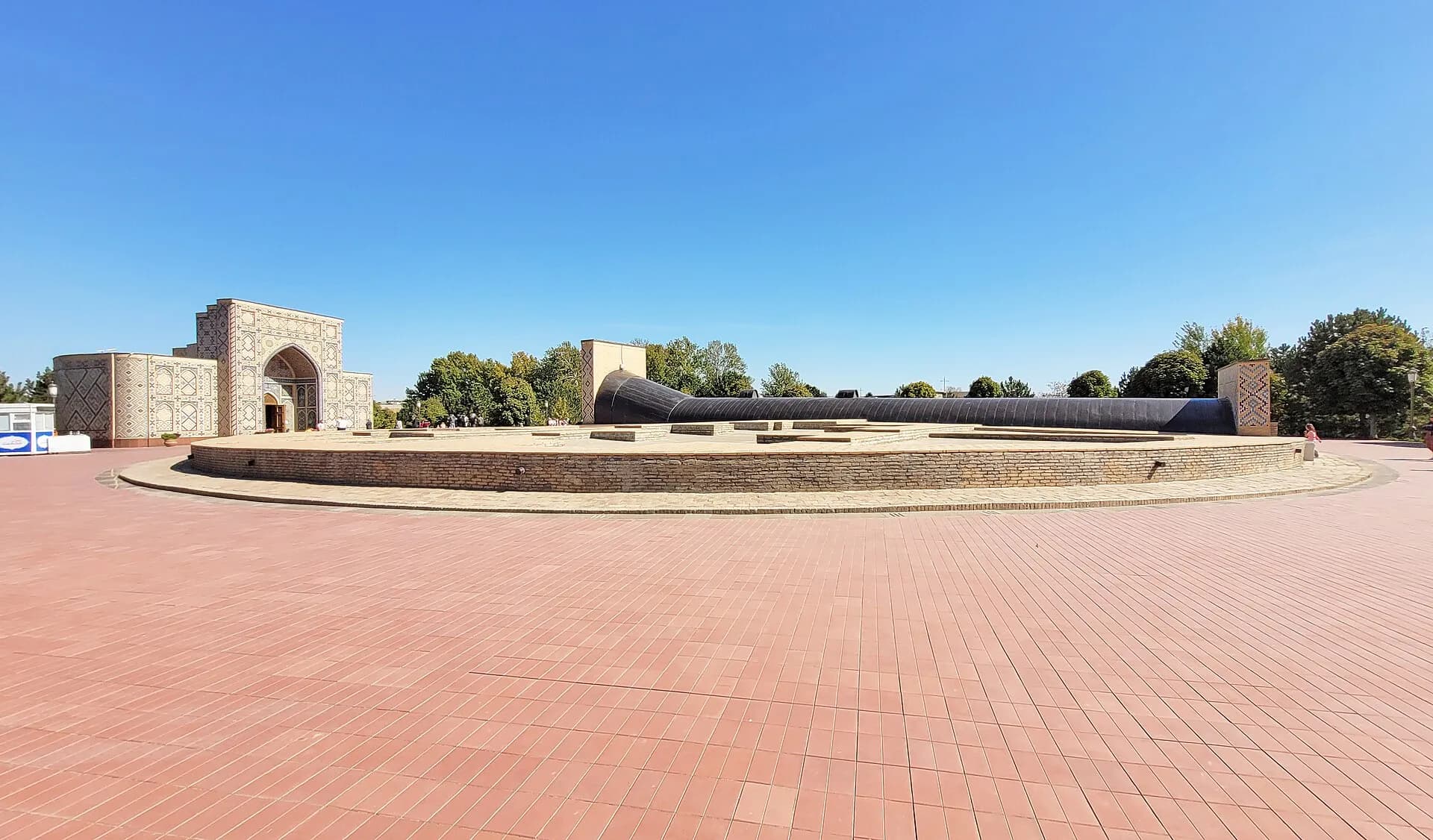
At Ulugh Beg's observatory, the most revealing question is how anyone measured the sky so carefully before telescopes. The surviving instrument channel offers a clue: this was architecture built around observation. In fifteenth-century Samarkand, royal resources supported a demanding program of mathematics, repeated measurements and scholarly collaboration.
1. Bigger instruments, smaller uncertainties
The observatory's great meridian instrument was fixed in position and built on an exceptional scale. A larger measuring arc made small angular divisions easier to read, while a stable setting reduced movement that could distort observations. Much of the building has disappeared. What remains below ground should be read alongside museum diagrams, not mistaken for the entire original observatory. Look for how the instrument was aligned, then imagine the work involved in returning to it night after night.
2. The catalogue was a collective achievement
Ulugh Beg was both a ruler and an astronomer. His court brought together scholars including Jamshid al-Kashi and Ali Qushji. UNESCO's history of the mathematical sciences describes a catalogue of 1,018 stars associated with this work in 1437. That number is impressive, but the greater achievement was producing positions precise enough to be useful. The project required calculation, comparison and correction. Giving the collaborators their place in the story makes the observatory more interesting than treating it as one ruler's solitary triumph.
3. What does astrology have to do with it?
In medieval courts, astronomical knowledge existed alongside beliefs about celestial influence, calendars and the timing of events. These subjects did not always occupy the separate compartments familiar today. Still, a star catalogue records celestial positions; it is not evidence that political events could be predicted by reading the heavens. When a guide describes Ulugh Beg's legacy, ask which claims concern measured observations and which concern the beliefs of the period.
Travel Tip
Pair the observatory with Ulugh Beg's madrasa at Registan. One shows the tools of research; the other helps place learning within the city's public life.
- When: During museum opening hours, with time for the diagrams.
- Where: The observatory site outside Samarkand's central monument circuit.
- The Vibe: A visit for anyone curious about how knowledge is made.
Include the observatory in a Uzbekistan journey, or contact Minzifa Travel to arrange more time for Samarkand's scientific heritage. Explore other tours and meet the team. Cover photo: The archaeological site and museum at Ulugh Beg's observatory, Samarkand. Photo: Bgag / Wikimedia Commons, CC0. Resized for web display.
Comments
Leave a comment
No comments yet. Be the first to share your thoughts!