Ganch Carving in Bukhara: Looking Closely at the White Hall
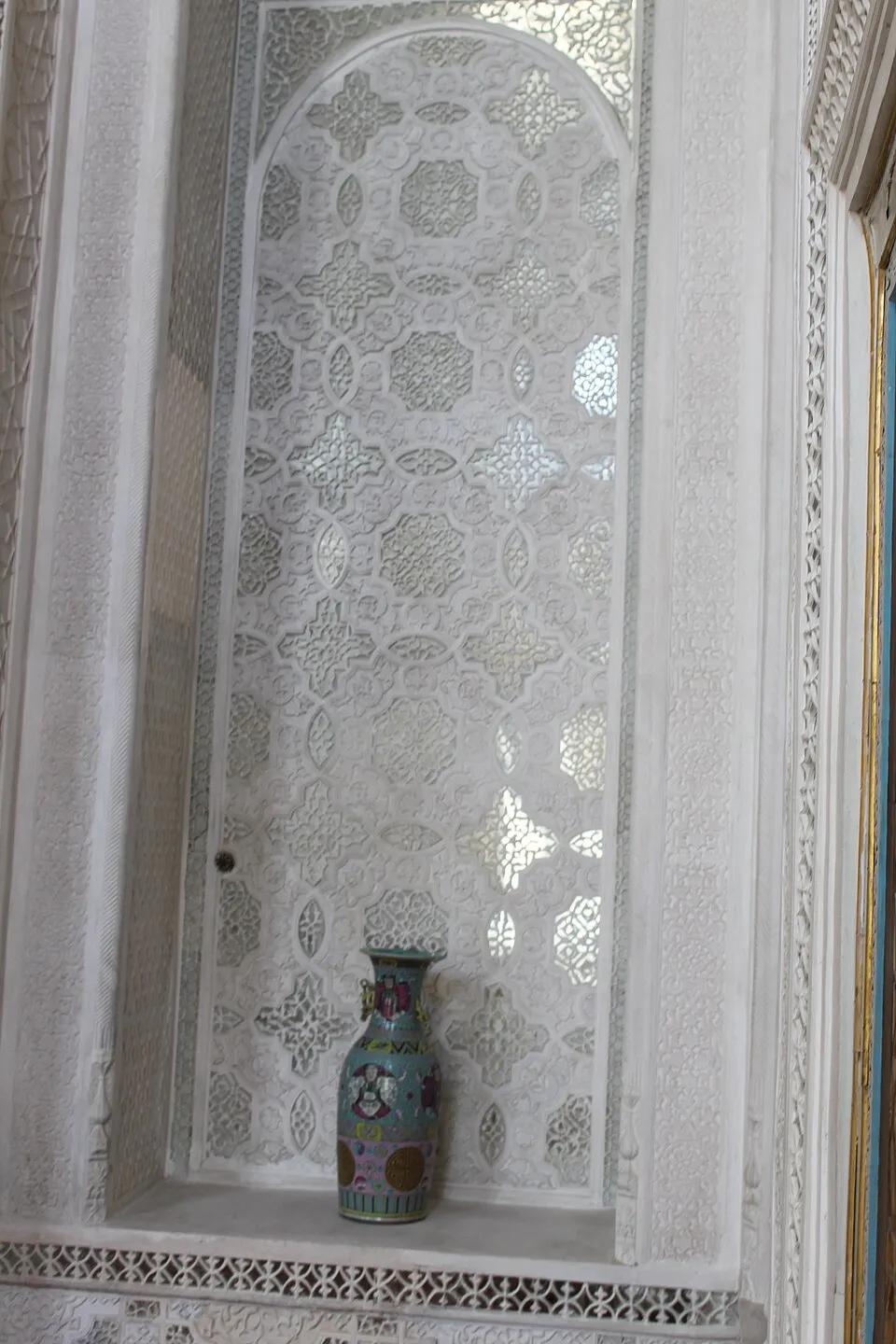
Give the White Hall a moment before reaching for the camera. At Sitorai Mokhi Khosa, the country residence outside Bukhara, pale carving and mirrored surfaces make it difficult to judge where a solid edge ends and a reflection begins.
This is a rewarding place to learn about ganch: the gypsum-based material that craftspeople turn into intricate architectural decoration. The room asks you to look closely, rather than simply register that a palace was luxurious.
1. Name the material correctly
Ganch is a local gypsum-rich plaster material, traditionally associated with mixtures containing clay. It can be shaped and carved into ornamental surfaces. A white carved panel is therefore not automatically marble, stone or carved wood.
Uzbekistan's cultural-heritage records describe ganch carving as an architectural decorative art. Museum-based research also distinguishes carved and cast decoration. Those distinctions matter: a visitor should not assume that every repeated element was cut individually by the same process.
2. Find the relationship between relief and mirror
In the White Hall, mirrored walls interact with the ganch decoration. Look for the small dark edges beneath projecting forms and the bright areas that change when you move your viewpoint. A reflection can make a shallow detail seem unexpectedly deep.
The national tourism portal associates the palace's interiors with the Bukhara masters Usto Shirin Muradov and Hassan Jana. The White Hall is particularly linked with Muradov in accounts of the palace. Naming a craftsperson makes the room easier to understand as accomplished work rather than anonymous ornament.
3. Read a panel in three passes
First, stand back and look at the panel's overall outline. Then follow one repeated unit: does it turn, mirror itself or connect to another? Finally, study the narrow edge where light separates one layer from the next.
You do not need to attach a hidden meaning to every curve. Describe what you can see, and ask the guide which pattern names or techniques are documented. Geometric organisation and plant-like forms can be discussed as visual choices without inventing a sacred explanation for each motif.
The cover photograph shows a detail of the White Hall. It is useful to compare that close view with the scale of the room when you arrive.
4. Place the room in the palace's history
Sitorai Mokhi Khosa's surviving palace setting belongs to Bukhara's later courtly history, including the early twentieth-century residence associated with the last emir, Said Alim Khan. It should not be described as an untouched medieval caravan palace.
The broader complex brings different decorative tastes into conversation. Ask how the guide distinguishes local workmanship, imported furnishings and later museum interpretation. The building is now presented as a museum of decorative and applied arts, so the collection and the architectural fabric deserve separate attention.
5. Let the craft remain visible
Hands leave marks on delicate surfaces, and a carved projection is not a handhold. Keep a sensible distance and follow the museum's photography rules. A close photograph taken with available light is preferable to moving a display object or leaning across a barrier for an angle.
Travel Tip
Include the palace as a separate excursion from Bukhara's old town, with transport and current opening arrangements confirmed. Request time specifically for the White Hall's ganch and mirrors. Ask Minzifa Travel to combine it with a craft-focused Bukhara programme.
Sources and further reading
- Intangible Cultural Heritage of Uzbekistan: Ganchkorlik
- World Society for the Study, Preservation and Popularization of the Cultural Legacy of Uzbekistan: ganch carving
- Uzbekistan Travel: Sitorai Mokhi Khosa and its interiors
Cover photo: Carved decoration in the White Hall at Sitorai Mokhi Khosa, Bukhara. Source: Sitori-i-Mokhi Khosa palace inside 2 white room detail.JPG. Credit: Faqscl. License/status: CC BY-SA 3.0. Web-optimised photograph remains available under the stated share-alike licence.
Comments
Leave a comment
No comments yet. Be the first to share your thoughts!