Shyrdak and Ala-Kiyiz: Two Ways Kyrgyz Makers Turn Wool into Pattern
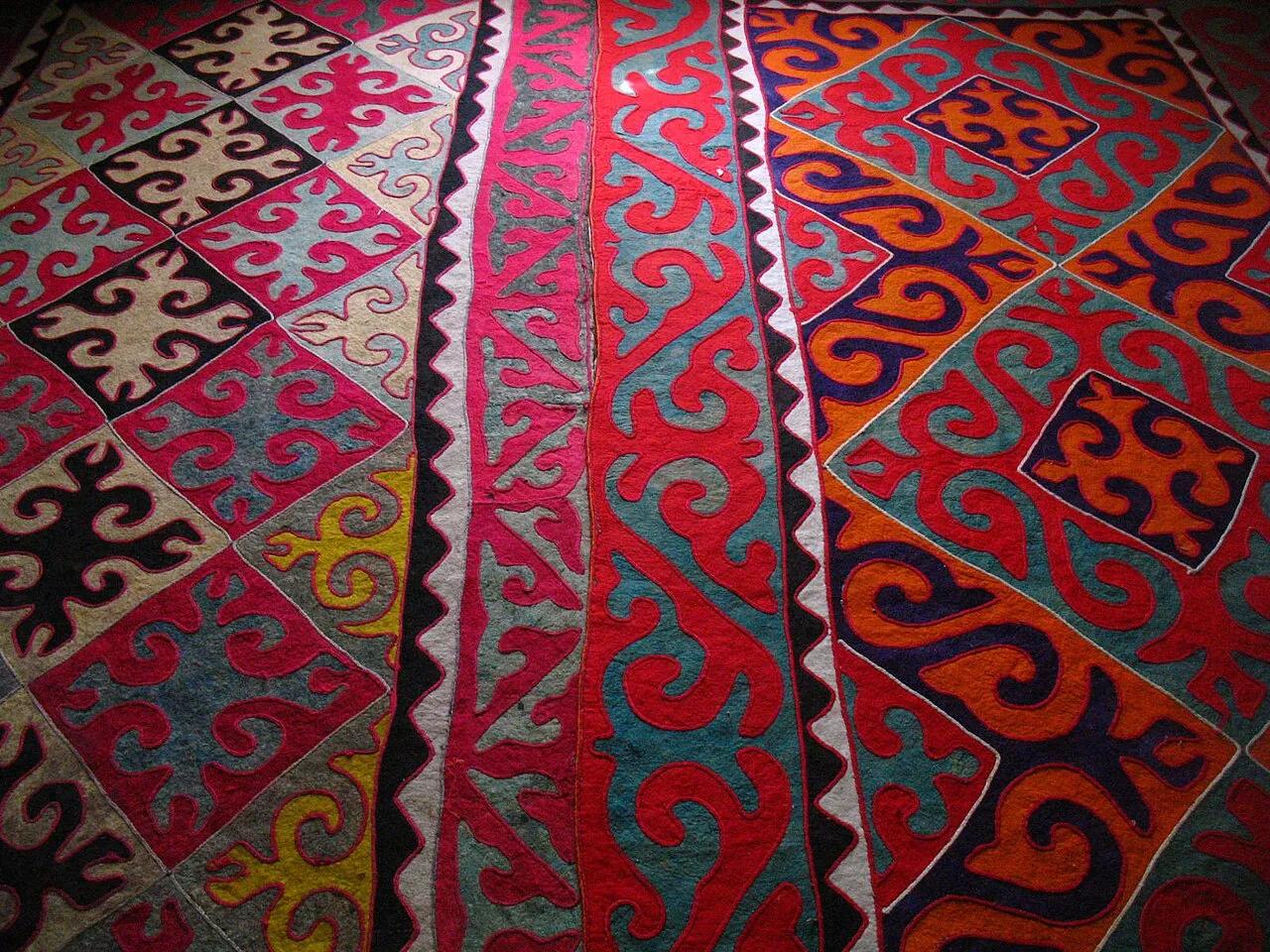
Look at the edge of a coloured shape on a felt carpet. Is it a cut piece joined to its neighbour, or does the colour appear worked into the felt itself? That small detail leads into two distinctive Kyrgyz traditions: shyrdak and ala-kiyiz.
Both belong to a history of making homes warm and visually expressive. Their techniques, and the knowledge shared while working together, matter as much as the finished pattern.
1. Follow the cut edge of a shyrdak
A shyrdak uses a mosaic or inlay approach. Contrasting pieces of felt are cut into corresponding shapes, rearranged and joined. A positive shape from one colour fits the surrounding shape from another, creating a strong relationship between motif and background.
Stitching, outlining cord and a supporting layer can become part of the construction. The crisp edge you notice is therefore evidence of how the pattern was assembled, not simply a decorative line drawn onto the surface.
Watch for the moment when a maker exchanges the cut pieces. It makes the logic of the design easier to understand than looking at a completed carpet from the doorway.
2. See the design felted into an ala-kiyiz
For ala-kiyiz, coloured wool is arranged into a design and felted together with the base. The pattern is created during felting rather than by assembling a mosaic of already finished felt pieces.
Its transitions can appear softer than the sharply joined forms of a shyrdak. These are useful clues, but ask the maker about a particular object: modern felt work can combine techniques, and appearance alone is not a full production history.
The cover shows a shyrdak in a Kyrgyz home, rather than an example of both processes at once.
3. Put the maker back into the pattern
UNESCO inscribed the Kyrgyz art of ala-kiyiz and shyrdak on the List of Intangible Cultural Heritage in Need of Urgent Safeguarding in 2012. Its account emphasises knowledge, community cooperation and transmission between generations.
That recognition concerns a living practice, not only old rugs stored in museums. A workshop visit is an opportunity to learn who prepared the wool, chose the colours, cut the pattern and joined the pieces.
Motifs may have names and associations explained through horns, plants or other forms. Let the craftsperson describe the design in front of you. A familiar curl need not carry one fixed sacred meaning across every region, family and contemporary product.
4. Buy with construction in mind
With permission, examine the whole piece and its reverse. Ask which parts are handmade, what materials were used and how the maker recommends cleaning and storing it. Size, weight and finishing may matter more to your home than an attractive photograph of one corner.
A small contemporary object can support skilled work just as a large carpet can. Ask for the maker’s name and keep it with the purchase; that preserves a more useful story than an anonymous label saying only “nomad art”.
Travel Tip
When booking, name the process you want to see: shyrdak cutting and joining, or ala-kiyiz felting. Confirm duration, participation and whether anything you make can be dry and ready before departure. Ask Minzifa Travel to include a suitable artisan visit in a Kyrgyzstan itinerary.
Sources and further reading
- UNESCO: Ala-kiyiz and Shyrdak, Kyrgyz traditional felt carpets
- World Crafts Council–Asia Pacific: felt-carpet techniques
- UNESCO: Art of the Northern Regions of Central Asia, felt products
Cover image: A shyrdak on the floor of a Kyrgyz home in Kyzyl-Jar, Aksy, Jalal-Abad; not an ala-kiyiz. Source: Shyrdak on floor.jpg. Credit: Firespeaker. License/status: CC BY-SA 3.0. Resized for web delivery; the adapted photograph remains under the stated share-alike licence.
Comments
Leave a comment
No comments yet. Be the first to share your thoughts!