Silk Road Scents: Rosewater, Musk and the Evidence of Perfume Vessels
Imagine trying to write the history of a fragrance after the liquid has disappeared. A bottle survives, perhaps with a narrow neck or a carefully shaped spout, but its last contents may be unknown. That gap makes the history of perfumery especially intriguing—and easy to overstate.
For a Silk Road traveller, documented objects provide a firmer starting point than an invented recipe supposedly unchanged since antiquity. They connect scent with materials, hospitality and exchange while leaving room for uncertainty.
1. Begin with a named sprinkler
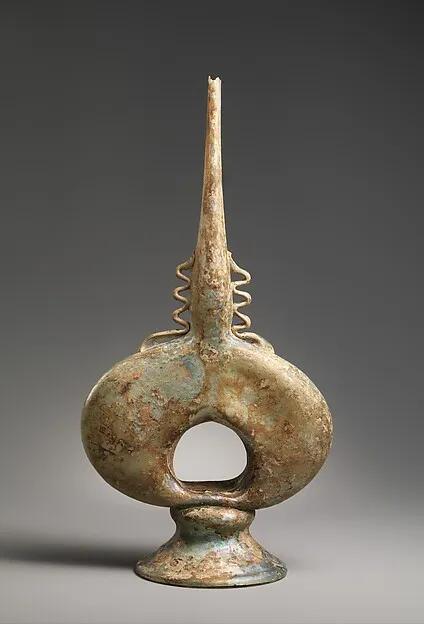
The Metropolitan Museum of Art's Perfume Sprinkler (Qumqum), object 1977.164, is attributed probably to Syria and dated to the eleventh through mid-thirteenth century. Its glass body forms a ring beneath a long neck.
The museum explains that it could dispense rosewater or another aromatic mixed with water, and connects rosewater with cooking and perfuming guests. This is evidence for a particular object type and social practice. It does not establish that this vessel reached Bukhara or that its contents followed one known caravan route.
The cover shows that object. Its date and attribution are part of the story, rather than a generic illustration of an unspecified “ancient perfume bottle”.
2. Compare another region and another material
The David Collection's bronze rosewater sprinkler, inventory 34/2000, is attributed to eastern Iran or Afghanistan in the tenth–eleventh century. Its animal-head spout contrasts with the Met's glass example.
The collection also supplies a useful caution: vessels of this type could function as sprinklers, but some may simply have held perfumes or fragrant oils. Shape supports interpretation; it does not automatically identify the exact substance once inside.
Seen together, the two objects suggest a rewarding set of questions about making, handling and serving scented liquids. They should not be collapsed into one standard design used everywhere along the Silk Roads.
3. Put musk beside the botanicals, carefully
Rosewater belongs to the botanical side of fragrance. Historical musk, by contrast, was an animal-derived aromatic. A discussion of scent should keep those origins distinct rather than call every perfume ingredient a flower or herb.
LACMA's catalogue of a twelfth-century perfume sprinkler discusses rose, musk and ambergris as possible sources of aromatics dispensed in small amounts. The Met's publication Jerusalem 1000–1400 likewise discusses rosewater and dilutions of other fragrant substances. These interpretations do not amount to a laboratory identification of the residue in every surviving bottle.
4. Let later objects show change
An eighteenth-century northern Indian perfume sprinkler in the Met, object 1975.194.1, carries colourful floral decoration. The museum connects such vessels with rosewater used to scent festive spaces.
Comparing it with the earlier objects shows why “Silk Road perfumery” needs dates. A later floral bottle can illuminate another chapter of fragrance culture without becoming evidence for an identical medieval custom in Central Asia.
5. Take better questions to a market
When shopping for a modern fragrance, ask about the listed ingredients, maker, intended use and whether “musk” refers to a contemporary fragrance accord. A historical name is not proof of an animal ingredient, a traditional recipe or a documented origin.
Enjoy the smell as a modern product first. A seller's story about an ancient recipe can be interesting, but should remain a story unless there is evidence connecting that product with a historical source.
Travel Tip
Save a museum object record before visiting a collection or fragrance shop. Ask to compare form, date and use, and follow the seller's guidance before testing a product. Contact Minzifa Travel to include museums and contemporary craft stops in a cultural journey; the museum objects discussed here are not claimed to be on display in Uzbekistan.
Sources and further reading
- The Met: Perfume Sprinkler (Qumqum), 1977.164
- The David Collection: bronze rosewater sprinkler, 34/2000
- LACMA: twelfth-century perfume sprinkler
- The Met: Jerusalem 1000–1400, catalogue
- The Met: eighteenth-century northern Indian perfume sprinkler
Cover photo: Perfume Sprinkler (Qumqum), probably Syria, 11th–mid-13th century, The Metropolitan Museum of Art, 1977.164. Purchase, Richard S. Perkins Gift, 1977. Source: Perfume Sprinkler (Qumqum). Credit: The Metropolitan Museum of Art. License/status: Public Domain / CC0.
Comments
Leave a comment
No comments yet. Be the first to share your thoughts!