Nurata’s Karez: Following Water Beneath a Dry Landscape
In a dry landscape, a line of small openings can reveal more than a large monument. Where they belong to an underground water system, the visible shafts are only fragments of an engineering work whose main purpose lies beneath your feet.
The Nuratau region around Nurata has documented underground waterworks. Understanding them begins with separating the different ways people collected, redirected and managed water—not imagining one enormous tunnel connecting every local spring.
1. Picture the slope before the shaft
In a classic groundwater-fed qanat, a gently sloping underground gallery intercepts water and carries it towards an outlet by gravity. Vertical shafts provide access along the route for construction and maintenance. Their line can make the hidden course visible at the surface.
The useful comparison is between the gradient of the ground and that of the gallery. The waterway can reach the surface farther downhill without a pump lifting water at every shaft. Its success still depends on the source, geology, workmanship and continuing upkeep.
2. Recognise that “karez” can cover different systems
Renato Sala’s chapter in the Underground Aqueducts Handbook distinguishes groundwater-fed qanats, tunnels carrying surface water and other arrangements involving wells and groundwater management. In West Central Asian usage, karez can be a broader term than a single textbook design.
The chapter documents concentrations in the Nuratau region, including the Selsai and Arasai valleys, and discusses regional evidence from surveys and historical reports. A row of openings is therefore a starting point for identification, not enough to determine the water source or date by appearance alone.
For a particular line, ask whether its gallery has been recorded, where its outlet lies and which observations support its interpretation. This keeps a local example distinct from a general diagram.
3. Leave room for several building periods
Underground irrigation has a long history across a wide region. That does not date every Nurata waterwork to antiquity, to Alexander’s campaigns or to one founding ruler.
The handbook discusses both early historical traditions and later activity, including documentary evidence relating to the sixteenth century. Construction, repair and renewed use can belong to different moments. The most useful date is the one supported for the specific system under discussion.
4. Keep Chashma in its own story
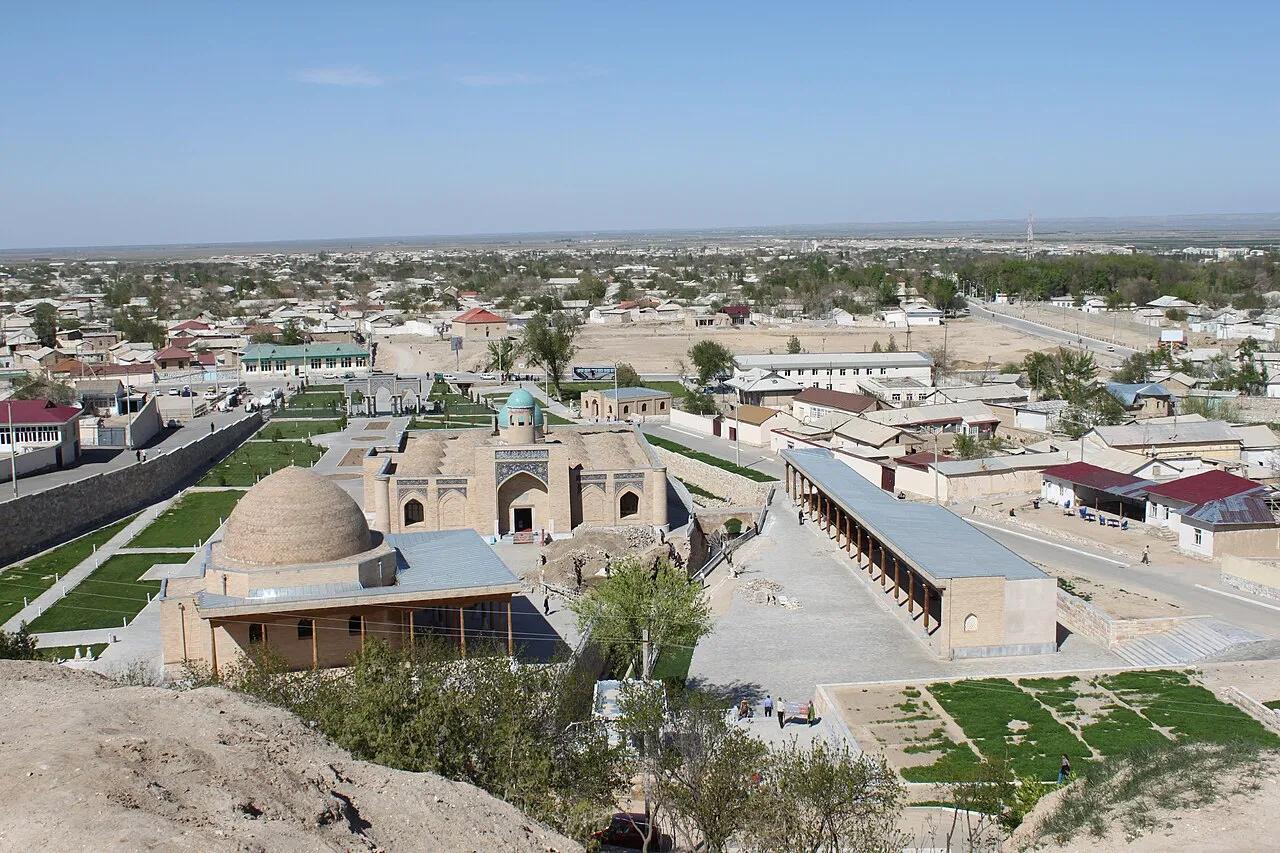
The Chashma complex is a public religious and spring setting in Nurata. It is a worthwhile place to observe water’s role in the town, but it is not, by itself, an accessible section of a surveyed karez gallery.
The cover shows the Chashma complex as context, not an underground tunnel. A visit there and a discussion of regional irrigation can complement one another without promising access to waterworks on private, agricultural or unstable ground.
If this subject appeals, compare it with the different solution described in our guide to Silk Road sardobas: storing water in a covered cistern poses different engineering questions from collecting it underground.
Travel Tip
Ask your organiser to distinguish a Chashma visit from a specialist irrigation excursion, and identify any proposed waterwork in advance. Stay clear of shaft edges and do not enter galleries. Contact Minzifa Travel to plan a Nurata stop with realistic access and suitable walking conditions.
Sources and further reading
- Renato Sala: Ancient Water Mining in Tunnels and Wells in West Central Asia, chapter
- UNESCO: the Persian Qanat, a comparison for groundwater-fed systems
- Uzbekistan Travel: Chashma complex in Nurata
Cover image: Chashma complex, Nurata, shown as local water-heritage context; this is not a photograph of a karez gallery. Source: Nurota Tchachma spring general view 1.JPG. Credit: Faqscl. License/status: CC BY-SA 3.0. Resized for web delivery; the adapted photograph remains under the stated share-alike licence.
Comments
Leave a comment
No comments yet. Be the first to share your thoughts!