Listening Beneath Samarkand’s Domes: Echoes, Reverberation and Whispering Galleries
Before looking up, try listening. Footsteps, a guide’s quiet explanation and the noise coming through an entrance can make a vaulted room feel very different from an open courtyard. Architecture reaches the ear as well as the eye.
Samarkand’s domed monuments offer an engaging way to think about that relationship. The physics is fascinating; the claim that a particular medieval mosque was deliberately built as a whispering gallery needs its own historical evidence.
1. Separate three things you might hear
An echo is a reflected sound heard as a distinct repetition. Reverberation is the lingering accumulation of many reflections, often merging into a continuous tail. A voice can sound prolonged without producing a clearly separated second word.
A whispering-gallery effect is more specific. In suitable curved enclosures, sound can remain concentrated near the boundary and travel along it. This is different from simply hearing your voice return across a large room. Rayleigh’s work on St Paul’s Cathedral is a classic reference for the phenomenon, not proof that every dome behaves in the same way.
2. Read the shape at Bibi-Khanym
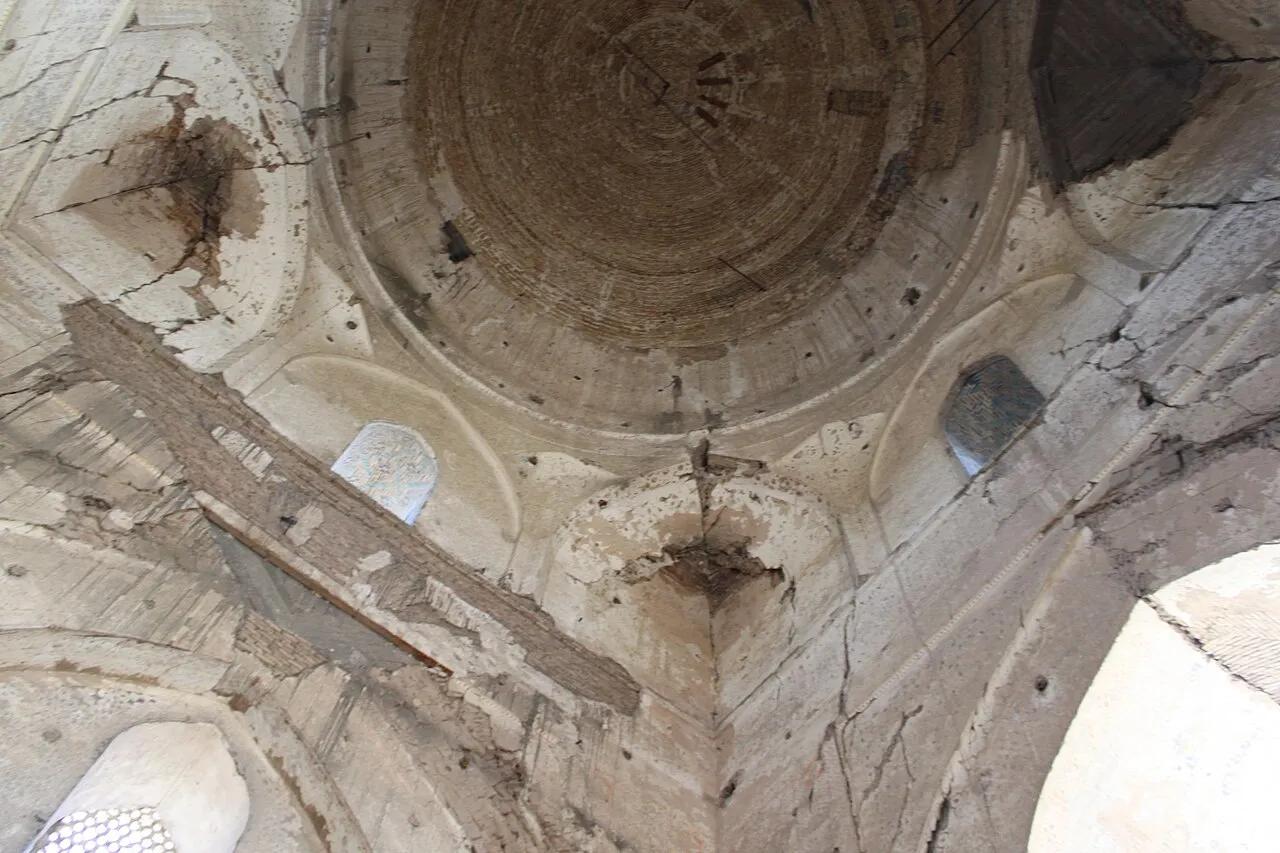
Archnet describes Bibi-Khanym’s inner domes as sphericonical, with outer domes rising above cylindrical drums. That distinction is useful: the turquoise profile seen outside is not the same surface that a voice encounters inside.
Curved reflective surfaces can redirect sound, sometimes concentrating reflections in particular areas. Openings, surface condition, furnishings and people also affect what reaches a listener. A photograph of a dome cannot establish the room’s reverberation time or the intelligibility of speech.
Archnet documents the building’s architecture and surviving fabric. It does not establish Bibi-Khanym as a measured whispering gallery, or identify acoustic communication as the intention behind its domes. Treat such a story as a question to investigate rather than a fact to repeat.
3. Notice how position changes the experience
If access and the setting permit, listen to ordinary speech from two allowed positions. Move a few steps rather than raising your voice. Does the sound seem clearer, more diffuse or more distant? Is noise entering through a doorway?
Those observations are worth discussing, even without a dramatic effect. They describe your encounter with the building on that day. They do not reconstruct how a medieval congregation heard it, especially where surfaces and surrounding structures have changed.
4. Let a quieter visit reveal more
Ask a guide to distinguish an architectural source from a modern acoustic study. If a remarkable effect is claimed, useful details include where the speaker and listener stood and whether the result was measured or simply noticed.
You can explore the same ideas while reading about Bukhara’s White Hall and its carved surfaces: different rooms invite different questions about materials and perception.
Travel Tip
Choose a quieter visiting period where possible, keep normal conversational volume and follow access rules. Avoid clapping, shouting or interrupting worship to test an echo. Ask Minzifa Travel for a Samarkand guide interested in architecture, with time for careful observation.
Sources and further reading
- Archnet: Masjid-i Bibi Khanum
- Simon Fraser University: sound–environment interaction
- University of Alberta: whispering-gallery modes and Rayleigh’s explanation
Cover image: Bibi-Khanym mosque, Samarkand: an archival view of the main prayer-room ceiling. The photograph is not an acoustic measurement. Source: Samarkand Bibi-Khanum Mosque - West Main mosque 91 - praying rom ceiling.JPG. Credit: Faqscl. License/status: CC BY-SA 3.0. Resized for web delivery; the adapted photograph remains under the stated share-alike licence.
Comments
Leave a comment
No comments yet. Be the first to share your thoughts!